
Into the Smog – Excerpt from Rebecca’s Secrets
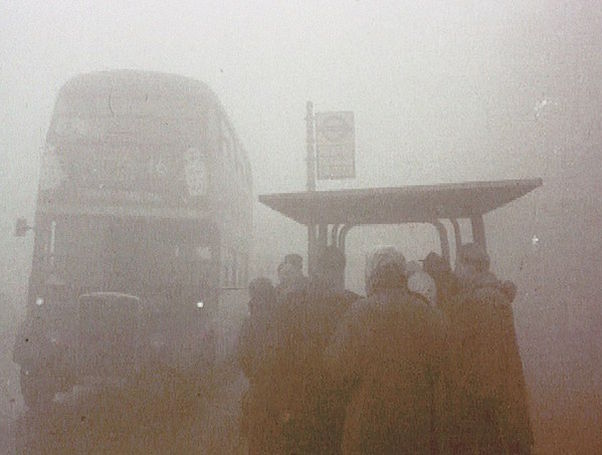
Christmas is coming and so is the smog and Tommy has to make his way to school through the biggest pea-souper of his life.
It was the last day of school before we broke up for Christmas. I woke in the dark, when I heard Granddad shut the street door as he left for work. I swung my feet over the bedside and padded into the kitchen. There was the familiar smell of cockroaches. I switched on the light, and a few scuttled away between the layers of brown lino, under the cooker and the cupboards.
It usually took me ten minutes to get out of the house on a school day, five minutes to run up Eric Street to Mile End Road, where I could jump on a bus or dive into the station to catch the tube.
My morning ritual was optimised for speed, so I could stay in bed in the warm as long as possible and still make it to school as the morning bell rang.
I filled a kettle and dropped it on the gas. I made a cup of tea for me (three sugars) and for Gran (no sugar because she had diabetes) and took her cup upstairs. I left it on top of the piano next to the jar with her false teeth. Gran was snoring.
I drank my tea and had cornflakes and milk. I always shook the cornflakes box first so any mouse droppings fell to the bottom.
I poured the remaining hot water into my washing bowl. I found the bowl in the Isaacs’ cellar. I expect Rachael washed her babies in it. We’d used it as a German helmet when we played war and then I brought it home. It was white enamel with a chipped blue rim – not much to look at, but it held water and it changed my life. Before then I used to wash upstairs in the scullery. It was icy in winter and we only had cold water. Now I could wash in the kitchen, which was near my room and a bit warmer and it saved me running up and down the stairs. I kept the bowl on top of the dresser – out of Gran’s reach. She might have claimed it for other uses. I kept the soap in the bowl, away from the cockroaches.
I washed my face and hands, emptied and stashed the bowl and jumped into my pants and school uniform – grey socks, a white shirt, which could last about three days, short grey flannel trousers, black lace-up shoes, which I kept laced to save time, a blue and white stripy tie, which I kept knotted to save time, and my navy blue blazer
I quickly folded the put-u-up away, grabbed my duffle bag and blue Gabardine raincoat, and snatched my dinner money and bus fare, which Granddad had left on the sideboard. I ran upstairs, popped my head round Gran’s door to say goodbye and rushed out into the street.
But the street had gone.
Where our doorstep ended there was nothing, just grey, stained yellow by the streetlight. It was dead quiet.
The smog usually started around November and came and went until January. The family talked a lot about the smog. Uncle Arthur told me about the first one, the Great Smog, in December, four years ago. He was down the docks driving a crane. He said it was a lovely day. He was supposed to be unloading timber from a Russian ship. The sky was blue above but when he looked down everything was covered in thick brown fog. He’d never seen anything like it. He had to stop work. When he came down he said it was like the blackout in the war – no light anywhere and you couldn’t see further than the end of your nose. He could hear birds crashing into the buildings and falling to the ground.
Uncle Sammy said some of the cattle in Smithfield Market dropped dead with the fumes. He said so many people died of pneumonia the undertakers ran out of coffins, and the funeral cars got lost on their way to the cemeteries. He said a whole family died in Ropery Street and the police had to knock down the door and found eight of them dead in their beds. He said it lasted four days and killed twelve thousand people.
Uncle Solly said Mr. Eden’s Clean Air Act was supposed to put a stop to it. No one was to use ordinary coal on the fire anymore. But he said it would take a long time, since no one could afford the smokeless.
I felt bad about all the death and suffering, but secretly I loved the smog. It meant I could legitimately get to school late.
This one wasn’t as bad as the Great Smog, but it was the worst I’d ever seen. If I stretched out my arm I could see my hand, but nothing beyond. I eased my way down to the pavement and turned right to head up the street. I tapped my right shoe against our steps, and then Abe Cohen’s steps Then I ran my hand along his railings.
That’s how I made my way up the street – doorstep, railings, doorstep, railings, Ronny’s, Mrs. Yershon, Mr. Levy’s, until I came to the end of the terrace. I knew the pavement carried on past the snooker hall yard, but there were no railings or fences to mark the yard’s boundary. It was a leap into nothingness.
Something came up behind me. I smelled it first – a disgusting shitty smell. I heard a stick tapping and then a grey mound appeared at my side.
“No problem for me, Tommy. It’s all a fog anyway.”
It was Old William.
“And the first shall be last and the last shall be first. Come on.”
I followed him up the street.
“Remember Tommy. Everything can turn around in a minute – in a heartbeat.”
You’re right, I thought – one minute you’re the smelly old tramp I felt sorry for, and next you’re leading me through the smog. My blind philosopher led me safely to Mile End Road, and disappeared as we came into the glow of the station lights. A small crowd huddled under the station canopy. They stamped their feet and blew into their gloves to keep warm, and complained about the smog.
“Bloody ’opeless, I’ll never get to work in this.”
“Yea, and it’s no bloody work – no bloody pay.”
“They don’t bloody care you got bloody mouths to feed.”
Their voices were curiously flat and carried only a few feet in the muffling fog.
I found the bus stop and joined a long queue, peering into the gloom. No buses passed. One car came crawling out of the smog, guided by a passenger leaning out of the window, calling instructions, “Slow down. Left a bit… No right…” A few more cars passed very slowly and a man on a bike, with his scarf tied around his face, his breath steaming through it.
Most of the people in the queue were masked with scarves so you could only see their eyes. Some were coughing – from the smog or the cigarettes. A lady behind me was in distress. She was coughing her lungs out! It was a wet guttural cough that seemed to come from deep in her chest. She was fighting to inhale between the spasms and then inhaling too deeply so the smog irritated her lungs and threw her into more violent coughing. She was panicking. I guess she thought it would never stop.
The man standing with her took his flask from his lunch bag. “Come on, Peggy, have some nice hot tea.” She drank a little and calmed down.
I wondered if she’d die today. I wondered if her kids would see her again. I wondered if they said goodbye when she walked out this morning.
I usually alternated between bus and tube – just for the fun of it, but this morning the roads were in chaos. It was freezing cold. The queue before me disappeared into the gloom and people were getting irritated. I headed for the underground – no smog in the tube.
The tube was an adventure. Each time I tried to find a different route to Old Street. I had already found nine routes. I could take the Central Line to Bank or Liverpool Street, change to either the Northern Line, Hammersmith & City, the Metropolitan or the Circle Line to Moorgate and then take the Northern Line to Old Street. Or I could start on the Hammersmith & City or District Line, opening up another six routes. These were all the most direct routes, and I believed there were many more to be discovered. Each route had it’s own character. Some trains were strewn with litter and full of people who smoked and coughed. Some trains filled with city people in dark suits, or mums with push chairs, toddlers and bags. Today the trains were packed solid with people who couldn’t get buses.
I went by the simplest route – Hammersmith & City to Moorgate. I had to squeeze my way in and stood holding the central pole between the doors. I fought my way off at Moorgate and was swept along by a wave of people in a hurry to get through the tunnels to the Northern Line. The train drew up as I reached the platform and although it was full, and the porter was letting no one on, a fat man at the door of the nearest carriage made a joke of sucking in his big gut to make room and pulled me in.
I wasn’t happy being crushed against his belly and he gave me funny looks and moved strangely, so I wriggled my way to the central pole. Unfortunately when the doors opened at Old Street, I couldn’t get across in time. I had to ride on to the next station, my station, Angel. Two working men had noticed my failure to cross the crowded carriage, and at Angel they each took one arm and lifted me off my feet. The other passengers thought this was great fun and passed me over their heads to the door. They cheered when I touched down on the platform. I turned and bowed deeply before running to get the return train to Old Street.
Outside the station the fog was just as thick as when I left Mile End. Luckily there was a stream of kids late for school. I joined the shuffling procession.
“Say you came on the bus.” One boy advised me. “They’ve hardly been moving. Then you won’t get into trouble.”
I didn’t think I’d get away without a detention, but I took his advice and it worked. In fact the teachers were pleased to see us for a change. They had the same trouble getting in as the boys.
The assembly hall was half empty, which created an unusual intimacy. Mr. Cowan launched into his usual morning rant reminding us we were all disgusting loafers skilled only in dropping litter, disobedience, insolence, fighting in the playground, stealing from cloakrooms, running in corridors and messing up the dining room. His words echoed harmlessly around the hall. Then he told us to behave over the holidays because wherever we went, in or out of uniform, we were always Central Foundation Grammar School Boys and must conduct ourselves in a way that would bring honour to the school.
The morning went as usual but a few afternoon classes were cancelled because teachers didn’t turn up, so we were told to catch up on our homework and left to our own devices. That meant climbing on desks, bundling in the aisles and general mayhem.
When we heard Mr. Spenser’s approaching footsteps in the corridor we dived back into our seats and pored over our books. He smiled through the classroom windows. We smiled sweetly back. He popped his head round the door and said “Happy Christmas boys.” and we called back “Happy Chanukah, Sir.”
When he’d gone, mayhem resumed.

 Robert hart
Leave a comment