
Best and Borrowed Clothes – Excerpt from Rebecca’s Secrets
Tommy has an interview at the Grammar School.
On the morning of the interview I woke to find a bar of Five Boys balanced on the arm of my put-u-up.
Granddad had left it. I didn’t wear my normal school things that day. I dressed top to bottom in my best clothes. My shoes were polished black, although they were too scuffed to shine.
I ironed crisp creases into my best grey flannel shorts. I struggled with my white shirt – the whalebones were missing from the collar, so no matter how hard I pressed, or how hot the iron, the wings curled up like Salvador Dali’s moustache. Although a few stains survived the wash, I covered them with a blue tie and an old navy blazer I borrowed from Ronny Needleman. With hair Brylcreemed neatly to one side, I was as shiny and clean as I could be.
Gran gave me a brown envelope and asked me to run it round to Mr. Levy’s. I protested, but ran off across the street, past a woman in a blue coat who was staring at Gran’s house. She turned away as I ran past her across the bomb site. I dodged abandoned bedsteads, jumped over walls and kicked a few cans on the way.
For a while now, Gran’s envelopes carried notes rather than change. This one was fatter than usual.
When I returned from Mr. Levy’s. Gran and I walked up the street to the bus. My socks had slipped down my skinny legs and bunched at my ankles, my collar and Ronny’s tie were twisted and my shoes were scuffed and scruffy.
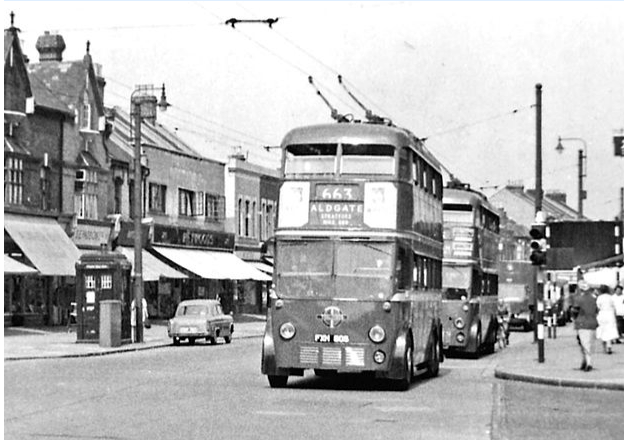
We caught a trolley bus, which was slower than the new diesel Routemasters. At the big junction at Gardiner’s Corner the power arms fell off the overhead cables. It took the conductor five minutes to hook them up with his long pole.
I watched a dog, caught in the middle of the traffic – a small black mongrel surrounded by buses, cars, taxis and bikes. Drivers shouted at the poor thing, which was spinning in tight circles desperately searching for a way out of its nightmare. It finally panicked and shot off randomly at top speed. A man on a bike swerved out of its way and fell, swearing. The crazed dog ran in front of two cars. The drivers braked hard to avoid it, but a third car drove straight into the dog. Headlight hit skull and they both shattered with a loud crack. As our bus drove away, a small crowd gathered round.
By the time we got off at Old Street, we were fifteen minutes late for the interview. I jumped to the kerb without looking and bumped into a girl, knocking her back into her mother’s arms. I only had a glimpse.
She was blond, about 13. She was with a tall dark-haired Jewish lady. They had nice clothes. I thought the girl would shout at me or even hit me, but she just smiled. I turned away quickly to help Gran down from the bus and, as fast as Gran’s arthritis would allow, we rushed off down Singer Street. I glanced back and the girl was still smiling.
We turned into Tabernacle Street, through the big gates into the playground of the Central Foundation Grammar School for Boys.
We were enclosed on three sides by a terrifyingly huge building. Three imposing blocks of brown brick containing a wild confusion of boys – hundreds of them in navy blue blazers. Some tore around the playground linked in strings of three or four playing chain-he, others chased tennis balls in small dusty crowds, pushing and clawing each other off the ball. Others stood in heaving bundles, shouting and tussling.
The noise was tremendous – trapped and amplified by the tall buildings. Gran froze, her eyes wide and darting all over like the dog at Gardiner’s Corner. I was frightened. We heard a long loud whistle. Every boy froze in mid flight and the playground was momentarily silent and full of statues. A tennis ball rolled to a stop by my feet.
Gran and I picked our way through the frozen boys towards the building on the right.
Another whistle and the kids unfroze and shuffled into long lines by the doors of each building.
We walked along the railings, up the wide steps and took the door labeled B Block. Inside it was like a prison. Above us a towering square stair well with glinting concrete steps spiraled up forever, enclosed by black railings. Everything was hard – polished parquet corridors, blue glossy walls, and cold black iron rails.
Gran steadied herself with one hand on the wall.
A door behind us burst open and a rush of boys spilled into the corridor, they tumbled noisily past us, like a sack full of coal thundering into our cellar.
“QUI-ET!” screamed a teacher at the top of his voice. He was standing right beside us.
The jostling mass streamed up the stairs and disappeared into the echoing corridors above.
“Hello, there, come for the interviews?” the screaming teacher asked softly.
Gran and I stared at him.
“Down there, to the right,” he said. “Headmaster’s Office.”
We walked where he pointed.
“Good luck.” He said as we turned into the corridor.
“I said, QUI-ET!” He bellowed up the stair well.
A dozen well-scrubbed boys and their Sunday-best mothers sat on a row of benches outside the Headmaster’s study. We were all there because we’d passed the eleven-plus and were applying for a place at this famous grammar school in the heart of the City of London. Everyone was nervous. The boys were fidgeting, swinging legs, biting nails and picking noses. The mothers were fussing with ties and shoelaces and cuffing the nose pickers with whispered threats that echoed along the corridor.
“Benjamin Jacobs!” a lady called and I spun round with relief to see Benny, my best friend from Stepney Jewish and his Mum.
“Hiya, Benny!”
He smiled as he walked past and held up crossed fingers for luck as he entered the Headmaster’s study.
The rest of us sat looking at each other until Benny and his Mum emerged five minutes later. They walked away to the far end of the corridor. Benny twisted round and gave me a thumbs-up before they turned out of sight.
“Thomas Angel!” the secretary called.
My stomach fell to the floor. The few yards walk to the Headmaster’s door was like a journey to the gallows. Every step took conscious effort. My legs had forgotten how to work. I thought about the frightened dog.
In the centre of the room was a big dark table. Five men sat behind it. They looked very severe and wore black academic gowns that looked like Batman capes. Gran and I sat on chairs in the big open space before them.
The Headmaster, Mr. Cowan, was a soft rounded man with pale skin and gentle eyes. He introduced himself and the rest of the ‘Panel’, which included Mr. Spencer the Deputy Head – an angular man with rocky cheekbones and a smile that kept trying to creep up one side of his face. At the end of the table sat someone he called the “Guvnor”, who must have been the real boss, and two others whose names I didn’t catch.
“We pride ourselves on our very high standards of behaviour and academic attainment.” said Mr. Spencer very quickly, as if he had said it a hundred times before, “Do you think you are capable of living up to them, Angel? With a name like that you should find it no problem!”
He smiled on the left side and raised his eyebrows.
No one ever called me Angel. I was Tommy, to my family and mates. Obviously I was in trouble, deep trouble – perhaps because we were late, or because my collar was curled up. My mouth went dry and my tongue doubled in size. It took huge effort to control.
“Er… what’sat, Sir?” It came out like a drunken drawl. It felt like talking with a gobstopper in my mouth.
Gran glared at me.
“Do you think, Angel,” Mr. Cowan said, slowly emphasizing every word, as if he was talking to an imbecile, “that you embody the social, moral and intellectual qualities that are required to make a significant contribution to the life of this great institution?”
“Don’t know, Sir.” I said – partly because I really had no idea what he was talking about and partly because I’d always found, when in serious trouble at school, that trying to explain or argue your way out always made things worse. If, on the other hand, you kept saying ‘I don’t know’ long enough, the teachers eventually gave up and let you off.
“Did you understand the Headmaster’s question, Boy?” the Guvnor spluttered.
“Don’t know, Sir.” All five of the Panel stared at me like I was something repulsive – I felt like a three-headed slug. Then they stared at Gran, who said,
“Sorry, Headmaster. He’s a bit of a luftmensh and a bit… well, slow, but he’s fine when he catches on.”
Nothing could redeem my situation. I was grateful to Gran for having a go, but I was sure it was exactly the wrong thing to say. The Grammar was for kids who were quick. Slow kids went to the Secondary Modern.
Ever since I found out Vinny had a hole-in-the-heart and a colostomy because he didn’t pay attention to his schooling, I believed that education would be my escape from poverty, crime, sickness, squalor and boredom. Now I’d messed up my best and only chance. I was done, finished, sunk. My potential would wither unrealized and my life would be a dead end street.
The Panel looked at each other, shrugged and raised eyes to the sky. “Well, Angel,” Mr. Spencer, mocked, offering me one last chance to redeem myself “dooo pleeease. If you would be sooo kind, tell the Panel why have you have chosen to apply to this school?”
“I like the uniform, Sir.” I chirped and smiled weakly.
They smirked at each other and gave me pitying ‘hopeless case’ looks.
I protested “But I do like the uniform, Sir. It’s really smart!”
They looked on in silent shock.
At Central Foundation Grammar School for Boys you wear long grey trousers in the second year, a dark blue tie, a smart navy blazer with a beautifully embroidered badge with the school coat of arms – not like the daft maroon blazer with green piping they got at Ben Johnson Secondary Modern.
“Thank you, Mrs. Angel” Mr. Cowan sighed. He didn’t look at me “You’ll hear in a couple of weeks. Next!”
We left the building in silence and said nothing on the bus all the way home. Gran stared in front of her. I stared out the window, looking for the girl I’d bumped into. Perhaps she was my sister somewhere in London. By the time we got to Mile End I’d seen three other blond girls, some a bit older some younger. Any of them could be my sister. I decided to find out more about her.
Outside the station, Gran bought the Evening News. On the front page was a big headline Suez – War in Egypt? But Gran wasn’t worried about impending war. She turned to the racing pages. She couldn’t make out the small writing and made me read the results of the 3:35 at Wetherby. I don’t remember which horse won, but it wasn’t Gran’s and we walked down Eric Street in silence.
During the next few weeks I stayed in. I listened to the radio, drew pictures, wrote poems, sorted my picture cards into ordered stacks. I arranged the 400 free sample stamps I got from Stanley Gibbons to replace my swapped collection, by country, then by theme (animals, transport, people), then by colour – all in a useless effort to stop thinking about the rough kids I’d be with at the secondary modern. The Grammar kids were scary, but the secondary mods were like Donkin and worse. They’d kill me.
After three weeks Gran got a letter. Despite my pathetic interview performance I had been offered a place at Central Foundation Grammar School for Boys. I thought they had taken pity on me because we were poor, but Vinny said it was because they hadn’t filled their quota of idiots.

 Robert hart
Leave a comment