
Saturday Night– Excerpt from Rebecca’s Secrets
Tommy’s whole family come together and a dark secret is revealed.
Every single Saturday night from as far back as I could remember – the whole family came round to Gran and Grandad’s.
They all gathered in my bedroom. With the put-u-up folded away and the drop leaf table extended for cards, it became a living room. As a compensation for getting the room ready every week, my cousin Louis (the younger) and I were allowed to roast chestnuts on the fire for all the kids.
There were lots of kids – Gran had six surviving children, all married except Vinny, so I had eleven uncles and aunts and twelve cousins. Everybody came on Saturday, plus Great Aunt Betty. With Gran and Granddad that meant twenty-six people crammed into the basement.
Little Louis and I squatted on either side of the hearth and speared chestnuts on toasting forks. When they were blackened, we threw them across the room to our various cousins, making sure they were still hot enough to burn their hands when they caught them.
From the hearth we could see everyone and make fun of them.
Auntie Hannah – tall, thin, dark and dignified stood with her back to the fire, skirt lifted, warming her bum. The uncles jeered, “Let the rest of us see the fire, Hannah.” But she just lifted her nose higher and surveyed the family. She was our moral guardian and was allowed and expected to make judgments on everyone else.
Louis was giggling about her blue knickers and the red blotchy patches on the back of her legs. I made him shut up. I liked Aunt Hannah – she stood up for me many times, and tonight she would come to my rescue again.
She was the oldest and wisest, among the aunts, and the most religious of the family – not really frum like the Jews from Stamford Hill and Golders Green – she shopped and traveled on the Shabbat – but she mostly ate kosher food and went to synagogue Friday evenings.
The family were Jewish by culture rather than religion. Gran was the only one who spoke any Yiddish and she only knew insults.
Most of them only went to synagogue for funerals. Some had married English husbands or wives. Everyone celebrated Christmas and Easter as well as Chanukah. Some of the kids had even been christened. Auntie Hannah and her Harry were the only ones who spoke Hebrew properly and could follow all the services. She did Pesach and Rosh Hashanah at home and fasted on Yom Kippur. Her son, Big Louie was the only cousin to have a Bar Mitzvah.
Aunt Hannah’s husband, Uncle Harry Diamond was short, round and smiley and well off. He collected silver ornaments for their sideboard. Big Louie was one of the cousins but he was so old he counted with the aunts and uncles. He was very intelligent, preferred Frank Sinatra to Buddy Holly and wanted to “get on in life”. He became a jeweler, married a pretty English girl called Shelley, and they had three Great Danes and two little girls.
Aunt Miriam sat close to the fire, near me. She was always cold. She looked much older than her sisters. She had a thin face, full of sorrow or disappointment. Like most of the family she smoked, but she had the worst cough and you could hear gurgling in her breathing. Her skin was wrinkly grey paper and the whites of her eyes were yellow with spidery red veins.
Her husband, Uncle Arthur was a docker – a jolly man who kept budgies and when I did or said something he thought clever, he called me, “Pretty Boy, Tommy. Pretty Boy!” like I was one of his birds. They had two girls, Esther and Rita, who tended to play together or hang around Aunt Miriam.
Uncle Solly and Uncle Sammy were twins, but like Rebecca’s twins Jacob and Esau, they didn’t look alike.
Uncle Solly had playful eyes and a wicked sense of humour. The Uncles revered him for his legendary ability to strip any lorry engine down to nuts and bolts and put it back together in better condition than when he started. He smoked cigars, which gave him an air of authority. He didn’t shave at weekends and by Saturday night had a chin like Desperate Dan, which he scraped on the kids’ delicate faces. Connie was his victim tonight. She screamed loudly and cried, but she really loved being the one chosen for his attention.
I always thought that Uncle Solly’s wife, Aunt Marlene, looked French. Her real name was Marlena – that must be French. Her clothes were flowery and shapely – as I imagined French women might wear and she moved, chuckled and talked with a sauciness that certainly was not like any Jewish or English woman I knew. She ran a bed-and-breakfast at their old house before they moved to Brokesley Street, and some of the aunts said she flirted with her lodgers. I don’t think she did – it was just that they weren’t used to Aunt Marlene’s ways.
Their daughter, my cousin Connie was only nine. Her little sister, Sarah, was just six – both too young to be interesting.
My other twin uncle, Uncle Sammy worked in the Davis Bros. Road Haulage yard behind Gran’s house, with Uncle Solly and Vinny. He was very good at finding things that fell off the backs of lorries. He would bring them over on Saturday and give them away or sell them. Miraculously, nothing was ever damaged by the fall. This explained why, no matter whose house I visited in the family, they all had the same red Formica fold-down kitchen table and a weird foreign coffee machine that no one could work.
I loved Sammy and Solly for their stories and jokes, but they scared me.
Vinny told me that Sammy and Solly were very brave soldiers and had fought side by side throughout the war. When it was over they went AWOL and commandeered a lorry. They filled it with army equipment, weapons and rations and drove it back to England, where they sold most of the stuff and stockpiled the rest. He said that’s how they started their business.
Connie once told me Uncle Solly had a shed full of army guns at the end of their back yard. I didn’t believe her, but whenever I was round their house I noticed no one was ever allowed to go near the shed. Once, playing football with Connie, I deliberately kicked the ball down the end of the yard and ran after it, towards the shed, hoping to take a peep inside. Uncle Solly suddenly appeared at the kitchen door and shouted in his deepest darkest voice, “Tommy. Keep away from there!” No one disobeyed Uncle Solly. After that, whenever I played in their yard I was careful not to even look at the shed.
Uncle Sammy was always joking with the men, but was frighteningly gruff with the children. If one of the kids fell and cut a knee, his wife, Aunt Nina would run to comfort them, but he would laugh. I know he loved his kids, but he didn’t seem to show it. He was always telling them off, although, to my puzzlement, at the same time he laughed at them whatever they did wrong.
The previous summer, during the school holidays, I went to stay for a week at Uncle Sammy’s. I loved staying at his house. It was on a nice clean street in Romford, with trees and grass verges. They didn’t have a concrete back yard with an air raid shelter, but a grassy garden, which spread all around the house, with a little goldfish pond and flower beds and a brightly coloured climbing frame and a swing for the kids.
The house was modern and clean and full of light. All the kids had real beds and there were no bed bugs, mice, rats or cockroaches.
There was a bathroom with white tiles on the walls, a proper white bath and a white sink to wash in, with hot water coming straight out of the taps. There were coloured towels and little plastic dishes with soap. It smelled of perfume.
Aunt Nina’s kitchen had diamond-patterned lino – not the thick brown peeling stuff Gran had. She also had the latest kitchen units, all in a line, fixed to the wall.
Next to the kitchen she had another small room with a washing machine and the latest stainless steel sink. She didn’t have to pummel the clothes and use a washboard and soap like Gran. She just put them inside the machine, closed the door, poured some powder through a hole and then watched them roll over and over, through the round window.
We used to eat at the red Formica kitchen table. It was a squeeze with seven of us and the baby.
We had roast dinner on Sunday, but it wasn’t like at Gran’s. They cooked a smaller roast, even though they had more people to share it. Aunt Nina put less on the plate, and the meat potatoes and veg were all separate. They didn’t have mash – just roast potatoes.
They finished off the leftover meat at Sunday tea. From Monday they had various combinations of spam, eggs peas and chips for tea – every day. I liked spam. I never had spam at home. Lucy complained every night and by Thursday she really had the hump.
“Spam again!” she said.
“Just you think yourself lucky there’s food in your belly.” Aunt Nina said.
“Yea, I know, lots of kids are starving.” Lucy said.
“Alright, you can have pilchards instead.”
Lucy retched.
When we finished tea, all the kids asked permission to get down from table. Uncle Sammy teased each one in turn for a while and then let them go. “Oh all right then, get off out of my sight.”
I never had to ask to get down at Gran’s and I was so scared to ask Uncle Sammy that I stayed long after all the others had gone. I had to join in their conversation, which was mostly about their friends – local people I didn’t know. It was strange to think that the adults had friends because I’d only ever seen family in Gran’s house. Eventually Uncle Sammy left, Aunt Nina cleared the table and sent me out.
“You’re a good boy Tommy,” she said, “the others never want to stay and talk with us.”
I played with Louie in the garden for a bit and then I asked him why they always had spam for tea.
“Only Monday to Thursday,” he said, and he led me to the utility room. At the opposite end to the washing machine was a pile of cardboard boxes, stacked almost to the ceiling.
“Look.” he said, “Dad said he liberated it from the army.”
Every box was stenciled “Spam x 100”.
“Blimey, Louis” I said, “That’s a lot of spam.”
He beamed.
I counted the boxes. “Let’s see… twenty four boxes times a hundred tins is…”
Louis looked up at me with his eyes wide and his lips pursed in anticipation.
“…Two thousand four hundred tins.”
Louis grinned.
I had watched Aunt Nina open two cans that night.
“So that’s… about eight cans a week. Two thousand four hundred divided by eight is …” I couldn’t do the division by eight in my head, so I divided by ten instead. “Two hundred and forty. You’re gonna eat spam for two hundred and forty weeks.”
“Blimey!”
“That’s… five years!”
Louis’s grin widened and then faded as admiration for my mental arithmetic was replaced by appreciation of what five years of spam would be like. He liked spam, but not that much.
“What’s this?” I asked, pointing to another pile of twelve boxes, with no stencil markings.
“Pilchards.” He said, “We have ‘em on Fridays. Lucky we go to Nan’s on Saturdays.”
While Uncle Sammy was respectful to Aunt Nina in his own home, on Saturday nights at Gran’s house, he constantly teased her in front of the other men. This disturbed me, because Aunt Nina was soft and warm and was always on the kid’s side – a safe haven for us all. She was light and giggly in a way that the Jewish aunts never were. She had lots of children:
Lucy was ten – a serious little girl, born middle-aged with a sense of morality – more like Auntie Hannah than her mum. But she did have Aunt Nina’s giggle, and was easily persuaded to join in any mischief her brother Louis and I got up to. Louis was seven and like a puppy – eager, with an up-for-anything sparkle in his eyes. He was full of life and great fun. Alice was eight, bonny and enthusiastic. Joey was only two and very quiet – watching everyone. Debbie was just a baby.
Aunt Stella was the youngest of the Aunts gathered at Gran’s. She was dark haired and had a pretty round face. She spent most of the evening asking Granddad if he wanted more tea, or a biscuit or something. She had the same wheedling smile that my mate Ronny put on when he was trying (always successfully) to get round his dad to buy him more Meccano.
Her husband was Lionel. Gran called him a groyse macher – a big shot showoff and said she didn’t trust him because he smoked the new filter tips.
Great Aunt Betty Levy was Gran’s sister. She sat in the chair by the fire opposite Aunt Miriam all night. She was very old, very wide and a bit scary. Her face was hairy, warty, dark and deeply furrowed like a walnut. Her voice was gravelly like the witch in Hansel and Gretel. But she was also kind to all the kids – gave us sweets which were always welcome and lung-crushing hugs and wet kisses, which were not.
So, with Uncle Vinny and me, that’s the whole family. Gran saw all her descendants every Saturday night. Except for the dead ones.
I knew about Uncle Louis who died in the war and Katy who died too young to become an Aunt or have her photo taken. Aunt Hannah told me her ghost came back the night Gran heard Uncle Louis had died in the war.
Great Aunt Betty asked me to fetch a cup of tea. When I got back from the kitchen, I asked her how many children Gran had altogether.
“Nine”
I recited them and counted them off on my fingers. “Sammy, Solly, Vinny, Dead Uncle Louis, Aunt Miriam, Hannah, Stella and Poor Dead Katy – that’s eight.” I said.
“You forget Sylv.” She said.
“Sylv.” I remembered the box with the wedding veil, “Sylv Angel.”
“That’s right, Tommy” she whispered, “don’t you forget Sylvie. They’d all like to forget Sylvie. They pretend she doesn’t exist.” That was the first time I heard that name said aloud.
Three generations crowded into the basement front room. The oldest women including Gran had the armchairs and pouffé near the blazing fire. Throughout the evening they exercised their matriarchal privileges, ordering any nearby child to turn up the radio, fetch tea, or a shovel of coal.
The kids kept moving most of the night to avoid being caught for more tea or coal. We played cowboys and Indians behind the settees, under the table, in the coal cupboard, up and down the stairs and out in the street.
The radio played the Archers, where Dan Archer and Walter Gabriel spoke a foreign language about “heifers, ewes, silage, and milk quotas”. The men around the dinner table smoked and drank beer and played cards – Klabyash. They spoke another foreign language – words like “trump, yoss, manel, and misere of aire”.
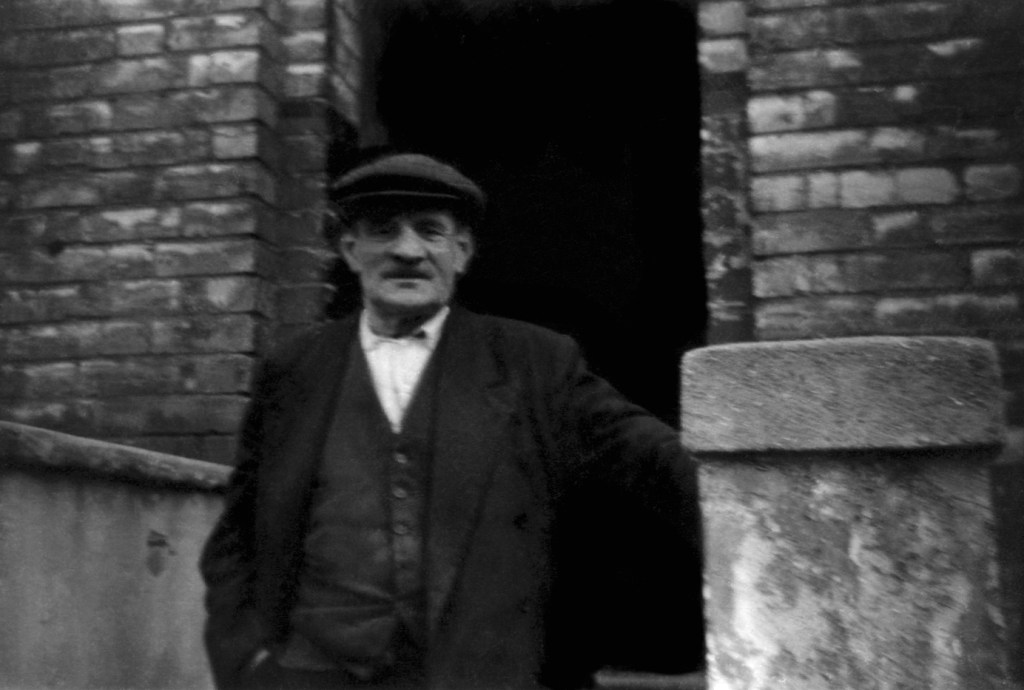
Granddad sat at the head of the table smoking Woodbines. Everybody loved him. He was kind, gentle, unassuming and full of humour. He was always making jokes and he told them like they were secrets.
One of my jobs was tearing up the newspaper for the toilet. I had to tear it into six inch squares and spike it on a butcher’s hook, which hung over a pipe on the lavatory wall. The job was boring and took too long, but Granddad could make anything into fun. He used to encourage me to use the saucy pictures from the News of the World, just to annoy Gran. Whenever I filled the butchers hook, I’d shout “Finished” and Granddad would say,
“So Tommy, now you’re the tallest boy in the world.”
I’d ask, ”Why’s that, Dad?”
“’Cos you can wipe your arse on the Evening Star!”
We’d laugh as if we’d never shared the joke before.
Granddad had been a boxer. He had a bent squashy nose and cauliflower ears to prove it. When Rocky Marciano retired undefeated-six-times-world-heavyweight-champion in April, Uncle Sammy said Granddad was better than Rocky, because Granddad never lost a fight and Rocky lost three out of forty nine.
Granddad was small like Rocky, slighter of build and he had a quiet strength that won everyone’s respect. The Uncles ribbed each other constantly, but they never teased Granddad. The Aunts argued about everything, but when Granddad spoke they listened without contradiction or protest, and Gran could go only so far with her continuous nagging and complaining – then Granddad would look her straight in the eye and she’d fall silent.
He would tell me “Tommy, you must take the best from everyone and let them keep the worst to themselves.”
I hoped I took all his best – his quiet strength, his kindness, his humour. I never saw any of his worst.
As the card games progressed the men would raise their voices and argue every trick. The room would fill with their bellowing protests, teasing and laughter. Granddad never raised his voice. Nor did he appear to be very interested in the game, until he’d smile quietly and play a flurry of tricks, win the hand and leave his sons speechless for a moment until they chorused “He’s bloody done it again!”
I usually kept an eye on Granddad’s pale ale. When the glass was empty, I’d ask, “Want another, Dad?” and fetch a refill. I had always called him Dad, even though I was confused and sometimes embarrassed about it. I knew he was my Grandfather, but Gran and Vinny called him Dad and so did I. No one seemed to mind. It gave me a special place among my cousins, who called him Granddad. They all thought I was their uncle, and Gran and Granddad were my Mum and Dad. I knew that wasn’t true, but until the summer of 1956 I didn’t know what was true and I went along with it. When I asked him, “Want another, Dad?” he’d respond with the same kindly, teasing tone he used with his sons, “Fill ‘er up, Tommy!” and I’d feel privileged and proud.
The Aunts took turns to lift their skirts and warm their bums by the fire, but spent much of their time in the kitchen. They all had neat, clean kitchens at home and were revolted by the thick layer of grease in Gran’s kitchen. It was everywhere, on the floor, walls, shelves and especially thick on the gas cooker. I’d tried to clean it many times, but it was beyond me. I’d run a cloth under the cold-water tap and scrub away at the grease. I had no effect. Later I found out about Brillo pads and, when I was old enough, I boiled kettles of water and learned how to mop the floor.
It wasn’t Gran’s fault. She was old, over sixty. She had been a very robust young woman – had a fish stall on the market and she was proud of it. She said our family, were fish people back through the generations – fish porters, fish traders and we knew everything about fish. She said she’d had her hands full of ice-cold cod and halibut for most of her life and now she was suffering for it. Now she was slow and weak. She had arthritis in her hands and diabetes, her eyes were bad and she was forgetful. She regularly made a big pan of bread pudding, stood on a chair to put it right on top of the dresser to cool and then forget it was there. Months would pass and the crust would get thicker and harder and covered in dust, grease and cobwebs, but the middle stayed edible, moist and succulent. I used to sneak in at night and cut a chunk for a midnight feast.
“I know she’s old, but this is really disgusting.” Auntie Hannah would say, “Why doesn’t Vinny do anything?”
“Are you joking?” Aunt Stella would sneer, “Have you seen his room? That boy needs a good woman to sort him out.”
They complained, drank gin and made huge piles of sandwiches – cheese, egg, ham (which Auntie Hannah always refused) and spam (which Uncle Sammy never refused) all served up on big oval platters, and endless pots of tea for the fireside matrons.
As the evening rolled on the men laughed louder and argued longer, until they lost concentration on the cards altogether and distracted into stories.
Granddad told how he worked for Costains the builders and used to put dead mice in his mate’s sandwiches. Sammy and Solly loved to tell stories about fights they had been in – during the war and since. They’d laugh loud when Solly told how he’d smashed his fist in an Italian’s face and his nose exploded. They told two versions of how Sammy’s hand was blown up when he either (depending on who you believed) saved his mates by catching a grenade and throwing it back at the Nazis or nearly killed his mates while messing about with one of his own grenades.
The men never spoke seriously about the war, and if Louie or I asked what it was like they’d say it was years ago and best forgotten. Instead they told the same stories every Saturday and argued over the same details.
I wanted to know more. I wanted to know how these men had been changed by the war. Sometimes I saw something in Uncle Sammy’s face, when he got annoyed at his kids. At first he’d laugh at their antics, then he’d pretend to be annoyed and growl at them, but sometimes he got really angry and shouted wildly. Then I’d see him suddenly stop and a look would flash across his face as fast as a blink – realization, horror and then composure – all in the tiniest fraction of a second. I imagined he was remembering what it was like to kill people. Uncle Solly and even Granddad must have killed people and they must have buried that horror somewhere inside them. That’s why they kept to a safe ritual of funny stories – to distract them and protect us from darker memories when they were their best and their worst.
Once I asked Uncle Sammy what the war was like, he said, “It’s not the last one you need to worry about, Tommy. The next one will be over in two minutes.”
“That’s all right,” Uncle Solly said, “we’ll get four minutes warning. So that’ll give us six minutes all together – just time for a quick one. L’chaim!” he raised his glass and finished his beer.
Under Sammy and Solly’s humour I suspected there was a darkness and something hard. I once overhead Aunt Marlene say that if it wasn’t for the Krays, Sammy and Solly could be running London. I didn’t know who the Krays were and what running London meant, but it frightened me.
While the men drank beer and became more merry, the women drank gin and became more melancholy. Aunt Marlene sat halfway up the stairs crying with Auntie Hannah comforting her, while Aunt Nina had a row with Aunt Stella in the kitchen. Granddad asked me to fetch more ham sandwiches. As I skipped in to the kitchen, I saw Aunt Stella sneering at Aunt Nina, whose eyes were red and tearful. Aunt Nina saw me enter and ran out. Aunt Stella twisted round to look and me and snapped,
“What do you want?”
“Aunt Stella. Dad asked if he could have some more ham sandwiches.”
“Haven’t you kids stuffed yourselves enough?”
“No, not for me… for Dad.”
“Little liar”, she said and her pretty round face distorted into a sneer.
“Honest, Aunt Stella, Dad sent me!”
“Honest, Aunt Stella, Dad sent me.” she mocked.
“Oh yes”, she said, “don’t we all know it. Little Tommy. Apple of his Daddy’s eye.”
I didn’t understand what was happening. I came in for sandwiches and now Aunt Stella was angry with me. She suddenly took my ears roughly in both hands and looked straight at me, eyes blazing,
“Well he’s not your Dad. He’s my Dad, right? You? You’re a bastard!”
“Why what’ve I done?”
“Nothing.” She pushed me away, with a look of disgust, “You can’t help it. You were born a bastard and you’ll always be a BASTARD! A bastard son of a WHORE!”
My face flushed, my eyes filled and my chin start to wobble. I couldn’t understand what I’d done to her. I shouted, “Sorry!” and ran up the stairs, out into the yard and climbed on top of the air-raid shelter, where no one could see me. I stayed there, head in hands, sobbing until the fire in my head began to subside. I dried my eyes and went to find the only adult I knew I could trust.
Auntie Hannah was with Aunt Marlene on the front doorstep. She said, “I know, Marl, all men are useless. You can’t trust any of them.”
I took her hand and pulled her into the dark passage.
“Auntie Hannah, I think I’ve upset Aunt Stella.”
“Why?”
“Well she swore at me.”
“What did you do?”
“I don’t know. I didn’t do anything. Honest. I just asked for Dad’s sandwiches.”
“What did she say?”
“She said he’s not my Dad. She said I was…” I hesitated to say a swear word to an adult “…a bastard.”
Aunt Hannah looked shocked and angry. I thought it was because I’d said the bad word, and I was in for a good telling off. But, no, she glared, not at me, but over my head into the darkness of the house and marched away towards the kitchen.
I don’t know what happened between them. Louis and I ran off to the air raid shelter. I showed him my treasures – some rifle shells, the gas mask, which he tried on and then the picture of the little blond girl in the red velvet dress. I watched his face when he looked at the photo. He was the first in the family to see it after me. He turned with his wide grin and said, “Pretty girl.”
I also kept a box with paper and coloured pencils we used to draw things together – cars, planes, mountains. We grabbed the box and ran upstairs to the lodger’s. Joe and Maurice were out, but they said I could use their living room whenever I wanted. There was a special reason tonight. I turned on their radiogram. I tuned into Radio Luxembourg, medium wave 208. Tonight, 25th May 1956 was the last episode of Dan Dare. We’d missed the beginning. We lay down on the floor in front of the speakers and drew Dan Dare and his spaceship.
“Oi, Louis. What’s a bastard?” I asked casually. He was younger than me, but at home he hung around with some rough kids and he knew things I didn’t.
“It’s a kid who ain’t got no Dad.” he replied just as casually, “Do a lady for me. Tommy.”
“What?”
“An old fashioned lady.”
“OK.” I knew what he liked. I drew a knight’s lady in a long flowing dress with long gloves, a pointed hat with ribbons flying.
“OK. Let me do it.” He said.
Louis drew a lady, more elegant than mine, with a fine profile, big soft eyes, and long lashes. She had flowing wavy hair and long sensitive hands. Her dress was delicately patterned with tendrils of vines. She stood alone on a rock looking over a calm sea, as the sun dipped into the water. It was beautiful.
“That’s really good, Louis.”
“She’s lost someone.” he said, “I wanna be an artist.”
“You can be Louis. You’ve got it in you. You can be anything you want.”

 Robert hart
Leave a comment